India now generates several million tonnes of electronic waste every year, and that volume keeps climbing as businesses launch more electrical and electronic products. Responsible e-waste management has moved from a nice-to-have to a legal necessity, built around the principle of Extended Producer Responsibility (EPR) — the idea that whoever places electronic equipment in the market shares responsibility for what happens to it at end of life. For businesses dealing in electrical and electronic equipment (EEE), this responsibility takes a concrete form: EPR Registration for E-Waste with the Central Pollution Control Board (CPCB).
The E-Waste (Management) Rules, 2022, along with subsequent amendments, created the current EPR framework, and relevant manufacturers, producers, importers, refurbishers and recyclers register and manage their obligations through the CPCB E-Waste EPR portal. But registration is only the entry point. Businesses that treat it as a one-time formality often struggle later with obligation calculations, recycler coordination, certificate tracking and return filing.
This guide walks through how to build a genuine EPR registration in e-waste strategy — covering documentation, applicability, obligation planning, recycler networks, certificate management and ongoing compliance monitoring — so your business can approach CPCB EPR registration as an organized, repeatable process rather than a scramble. Regulatory procedures and portal requirements evolve, so always confirm current requirements directly on CPCB's official resources before you file.
What Is EPR Registration for E-Waste?
EPR Registration for E-Waste is the process by which producers, manufacturers, refurbishers and recyclers of electrical and electronic equipment register with the CPCB to formally take on their Extended Producer Responsibility obligations under India’s e-waste rules.
Extended Producer Responsibility means the entity that manufactures, imports or brands an electronic product is also accountable for ensuring that product is collected and recycled responsibly once it reaches end of life. The CPCB E-Waste portal is the single window where eligible stakeholders register, report product and sales data, track their EPR obligation, purchase or generate EPR certificates, and file periodic returns.
It’s worth being clear on one point: EPR registration is not the same as ordinary business registration (like company incorporation or GST). It is a sector-specific, product-linked authorisation tied to your role in the e-waste value chain. And registration itself does not close out your compliance obligation — it opens an ongoing relationship with the regulator that includes obligation fulfilment, certificate management and return filing.
Who Needs EPR Registration for E-Waste in India?
Applicability generally extends to the following categories, though the exact scope depends on your business activity and the product categories covered under the applicable Schedule:
- Manufacturers of electrical and electronic equipment (EEE)
- Producers who sell EEE under their own brand
- Importers bringing applicable EEE into India
- Brand owners who get products manufactured by third parties
- Refurbishers who recondition and resell electronic products
- Recyclers and dismantlers processing e-waste
- E-commerce and online sellers introducing applicable EEE to the Indian market
Who Should Check Applicability? — Quick Checklist
- Does your product fall under a Schedule covered by the e-waste rules?
- Do you manufacture, brand, import or refurbish the product, or only distribute it?
- Are you already registered under an older authorisation that needs to be migrated?
- Have your product lines or import volumes changed recently?
Important: Not every electronics-related business automatically requires EPR registration. Applicability depends on your exact role and product category under the current rules — assess this carefully, or with professional help, before assuming registration is or isn’t required.
Why Do Businesses Need a Strategic E-Waste EPR Plan?
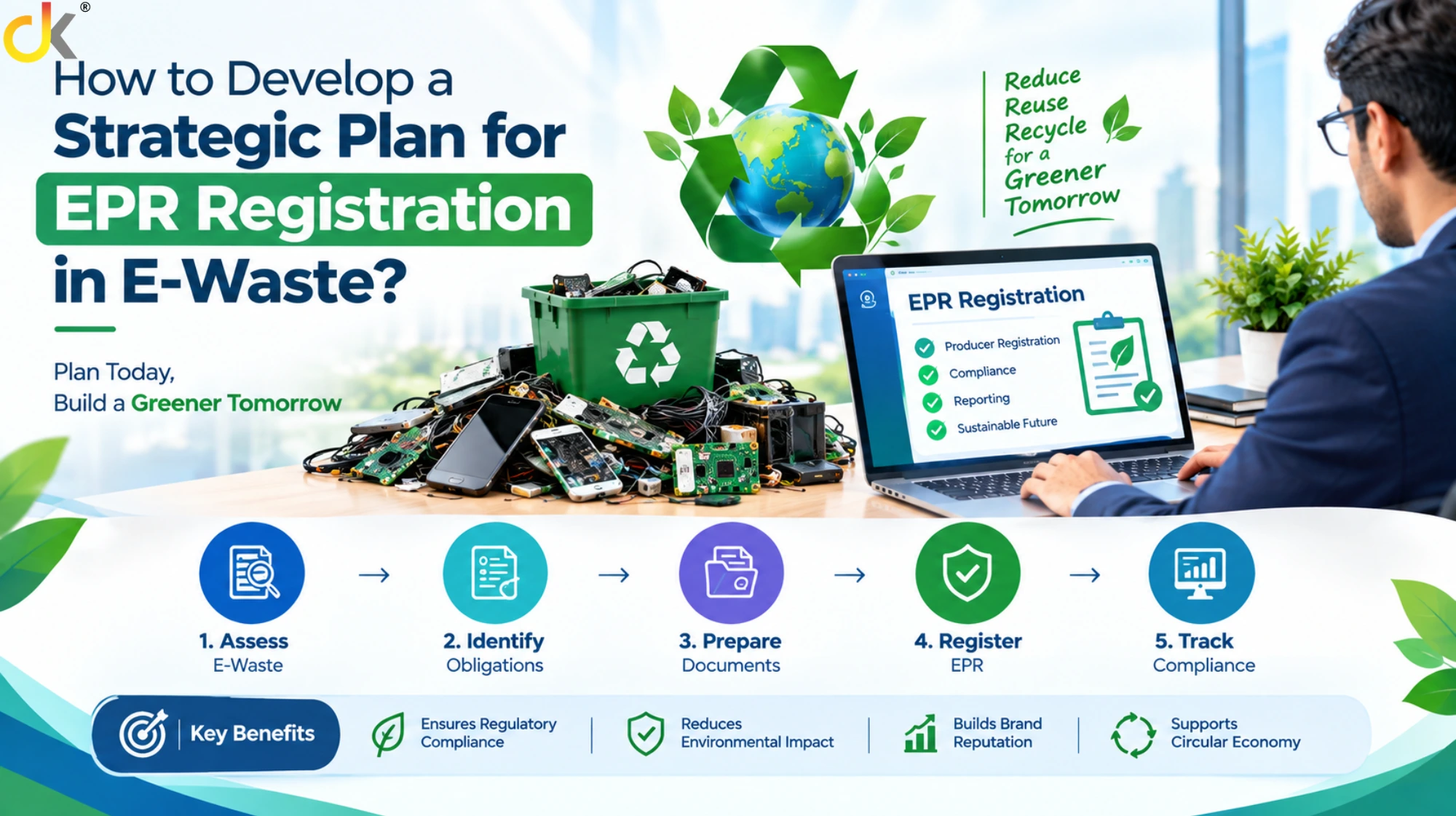
Registration is the first link in a longer chain. A strategic approach treats it as part of a continuous cycle: Registration → Obligation Management → Recycling → Certificate Management → Returns → Ongoing Compliance.
A structured plan helps businesses with:
- Meeting regulatory requirements without last-minute scrambling
- Accurately managing and tracking EPR obligations
- Planning recycling volumes ahead of deadlines
- Maintaining clean, audit-ready product and sales data
- Avoiding documentation errors that delay applications
- Organizing EPR certificate purchases and records
- Tracking filing deadlines and avoiding missed returns
- Reducing overall compliance and penalty risk
- Strengthening environmental and sustainability credentials
How to Develop a Strategic Plan for EPR Registration in E-Waste?
Use the ten-step framework below to move from applicability assessment through to long-term compliance management.
Step 1: Determine EPR Applicability
Start by identifying your exact role — manufacturer, producer, brand owner, importer, refurbisher or recycler — and mapping your products against the applicable EEE Schedule. This determines whether registration is required at all, and under which category.
Step 2: Identify and Classify Your Products
List every product line by category, specification and applicable EEE classification. Separate imported products from domestically manufactured ones, and own-brand products from those manufactured by third parties. Record approximate sales or import quantities. Accurate classification here directly affects your obligation calculation later, so this step deserves real care rather than rough estimates.
Read More - EPCG Scheme Benefits: How to Use EPCG for Business Growth
Step 3: Collect and Verify Business Documents
Assemble your core business and product documentation before starting the online application. A practical checklist:
- PAN of the business entity
- GST registration details, where applicable
- Certificate of incorporation or business registration proof
- Registered address proof
- Authorized signatory identification and authorization letter
- Product and EEE classification details
- Sales, import or production quantity data
- Technical or product specification documents, where applicable
- Any declarations or undertakings CPCB currently requires
Step 4: Create a CPCB EPR Registration Roadmap
A typical application journey moves through these stages:
- Portal account creation and login setup
- Entering business information
- Adding product and category information
- Uploading required documents
- Submitting the application
- Responding to CPCB queries or clarification requests
- Receiving the registration outcome
- Beginning post-registration compliance activity
Processing timelines vary with application completeness, product category and CPCB’s review workload — avoid assuming a fixed approval window.
Step 5: Calculate and Plan EPR Obligations
Your EPR obligation is generally linked to the quantity of covered products you have historically placed in the market, measured against recycling targets that increase over time under the current framework. Getting this right requires clean historical and current sales data — obligations should never be estimated casually, since both under- and over-estimation create downstream problems.
Always check the latest official CPCB methodology and target percentages for your category, since recycling targets and calculation rules are periodically revised — for instance, sector reporting has noted an upward step in recycling-target percentages in recent years. Independent bodies such as NITI Aayog also periodically publish circular-economy assessments that summarise how e-waste recycling targets are trending nationally.
Step 6: Build a Registered Recycler Network
Identify recyclers that hold valid CPCB registration, verify their current authorisation status, and understand their processing capacity before entering agreements. Maintain copies of agreements, invoices and processing records. Working only with verified, registered recyclers protects your certificates from later being challenged and keeps your compliance trail defensible.
Step 7: Develop an EPR Certificate Management Strategy
An EPR certificate represents recycling activity carried out by a registered recycler that can be used to offset a producer’s obligation. CPCB’s portal facilitates the generation and transfer of these certificates between recyclers and producers, alongside the associated online return process. Build a simple internal log that matches each certificate to the obligation year it offsets, and retain transaction evidence — invoices, transfer confirmations and portal records — in case of future verification.
Step 8: Plan Return Filing and Record Keeping
Maintain a running record of sales and product data, recycling activity, EPR certificates, registration documents, and recycler agreements or invoices. Build an internal compliance calendar around whatever periodic (e.g. quarterly or annual) filing requirements apply to your category, so returns are prepared ahead of deadlines rather than at the last moment.
Step 9: Establish an Internal Compliance Monitoring System
Assign clear internal ownership for tracking: registration status, EPR obligation progress, recycling activity, certificate balances, upcoming filing deadlines, new product additions, business detail changes, rule amendments and CPCB portal updates. Even a simple shared tracker prevents small oversights from becoming compliance gaps.
Step 10: Review and Update the Strategy Regularly
Revisit your EPR strategy whenever your product lines change, new products launch, sales volumes shift materially, business details change, rules are amended, CPCB updates portal requirements, or recycling targets are revised. CPCB has periodically issued amendments and updated SOPs and FAQs over time — which is exactly why a strategy built once and never revisited tends to fall out of date.
Documents Required for EPR Registration for E-Waste
Exact requirements vary by stakeholder category and current CPCB procedure, but the following categories are commonly required:
|
Document / Information |
Purpose |
|
PAN |
Business identification |
|
GST details, where applicable |
Tax and business verification |
|
Business registration / incorporation documents |
Entity verification |
|
Address proof |
Business location verification |
|
Authorized signatory details |
Application authorization |
|
Product / EEE information |
Product classification |
|
Sales / quantity data |
EPR obligation assessment |
|
Technical / product documents |
Product verification, where applicable |
|
Declarations / undertakings |
Regulatory compliance |
|
Other CPCB-required documents |
Application-specific requirements |
EPR Registration Process for E-Waste Through CPCB
At a glance, the process runs: Assess Applicability → Prepare Information → Register/Login → Enter Business Details → Add Product Details → Upload Documents → Submit Application → Respond to Queries → Obtain Registration → Manage EPR Compliance.
Each stage feeds the next — incomplete business details or product data at an early stage typically surfaces as a query later, which extends your timeline. Submission does not guarantee approval; CPCB reviews each application against current requirements before issuing registration.
How to Create an E-Waste EPR Compliance Calendar
A simple recurring calendar keeps obligations visible instead of surfacing as surprises near a deadline:
|
Activity |
Suggested Frequency |
|
Registration details review |
Annually / on business change |
|
Product data updates |
As new products launch |
|
Sales data tracking |
Monthly or quarterly |
|
EPR obligation review |
Quarterly |
|
Recycler coordination |
Ongoing / quarterly |
|
EPR certificate tracking |
Ongoing |
|
Quarterly compliance activities |
Quarterly |
|
Annual return preparation |
Annually, ahead of deadline |
|
Regulatory update monitoring |
Ongoing |
Common EPR Registration Mistakes Businesses Should Avoid
- Applying without first checking applicability
- Incorrect product or EEE classification
- Incomplete or mismatched documentation
- Inaccurate product or sales data
- Ignoring EPR obligations after registration is granted
- Working with unverified or unregistered recyclers
- Poor EPR certificate record-keeping
- Missing return filing deadlines
- Not updating registration details after business changes
- Relying on outdated compliance information
- Treating registration as a one-time activity
- Ignoring CPCB notifications and rule amendments
How to Maintain E-Waste EPR Compliance After Registration?
- Maintain accurate, well-organized records
- Monitor EPR obligations continuously, not just at year-end
- Work only with eligible, currently registered recyclers
- Track EPR certificates against obligations
- File applicable returns on time
- Update business and product information when it changes
- Monitor regulatory amendments and portal updates
- Retain supporting evidence for all compliance activity
- Conduct periodic internal compliance reviews
Benefits of Having a Strategic EPR Compliance Plan
- Better regulatory preparedness
- Fewer documentation errors
- Clearer compliance tracking
- Easier EPR certificate management
- Better-coordinated recycling activity
- Reduced risk of non-compliance
- Stronger record-keeping discipline
- Improved operational efficiency
- Stronger sustainability credentials
- Better long-term environmental management
A strategic plan improves organization and reduces risk — it does not guarantee regulatory approval or eliminate the possibility of penalties for non-compliance.
Why Choose [Your Website/Company Name] for EPR Registration for E-Waste?
Navigating EPR Registration for E-Waste alongside day-to-day business operations can be time-consuming, especially when applicability, product classification and obligation calculations are involved. [Your Website/Company Name] works alongside businesses at every stage of this journey, offering:
- EPR applicability guidance
- EPR registration assistance on the CPCB portal
- Documentation support and review
- Product and category assessment
- EPR obligation and compliance planning
- Recycler and EPR certificate guidance
- Return filing support
- Ongoing compliance monitoring
- Regulatory amendment and update assistance
[Your Website/Company Name] does not guarantee approval, specific timelines, or elimination of compliance risk — our role is to help you prepare a complete, accurate application and a sound ongoing compliance process.
EPR Registration for E-Waste — Quick Checklist
- Check whether EPR applies to your business
- Identify the applicable product category
- Prepare business information
- Collect required documents
- Prepare product and sales data
- Create or access the CPCB EPR portal account
- Submit the registration application
- Respond to CPCB queries if required
- Obtain and maintain registration
- Calculate and monitor EPR obligations
- Coordinate with registered recyclers
- Track EPR certificates
- File applicable returns
- Monitor regulatory updates
Conclusion
EPR Registration for E-Waste is the starting point of a much bigger compliance responsibility, not the finish line. A sound strategy runs from applicability assessment and accurate documentation through obligation planning, recycler coordination, EPR certificate management, and disciplined return filing and record-keeping. Businesses that build this as a repeatable process — rather than a once-a-year scramble — tend to face fewer compliance surprises and stronger sustainability credentials over time.
If you’re starting out, begin with an honest applicability assessment, and bring in professional guidance where the process feels unclear. [Your Website/Company Name] can help you plan and manage your EPR Registration for E-Waste from first application through ongoing compliance — reach out to get started.
Frequently Asked Questions
1. What is EPR Registration for E-Waste?
It is the CPCB-administered registration that formally brings manufacturers, producers, importers, refurbishers and recyclers of electrical and electronic equipment into India’s Extended Producer Responsibility framework for e-waste, along with the obligations that follow it.
2. Who needs EPR Registration for E-Waste in India?
Manufacturers, producers, brand owners, importers, refurbishers and recyclers dealing in EEE covered under the applicable Schedule generally need registration. Exact applicability depends on your role and product category, so assess your specific situation rather than assuming.
3. How can I get EPR Registration for E-Waste?
Assess applicability, prepare business and product information, gather required documents, and apply through the CPCB E-Waste EPR portal. The application is reviewed by CPCB, which may raise queries before granting registration.
4. What is the EPR Registration process for e-waste?
Broadly: assess applicability, prepare information, register or log in to the portal, enter business and product details, upload documents, submit the application, respond to any CPCB queries, and obtain registration before beginning ongoing compliance.
5. What documents are required for EPR Registration for E-Waste?
Commonly required documents include PAN, GST details where applicable, incorporation or business registration proof, address proof, authorized signatory details, product/EEE information, sales data, and any declarations CPCB currently prescribes.
6. Is EPR Registration mandatory for electronic products?
It is mandatory for eligible manufacturers, producers, importers, refurbishers and recyclers dealing in EEE covered under the applicable rules. Whether it applies to a specific business depends on its role and product category.
7. What is the role of CPCB in E-Waste EPR Registration?
CPCB administers the national e-waste EPR framework: it operates the registration portal, reviews and grants registrations, sets or publishes obligation methodology, and oversees EPR certificate generation, returns and compliance monitoring.
8. What is an EPR certificate for e-waste?
An EPR certificate is generated when a registered recycler processes e-waste, and it can be used by a producer to demonstrate that a corresponding quantity of its EPR obligation has been fulfilled through verified recycling activity.
9. How are EPR obligations calculated for e-waste?
Obligations are generally linked to the quantity of covered products a business has placed in the market, measured against applicable recycling-target percentages that can change over time. Always confirm the current methodology on CPCB’s official resources.
10. How can a business fulfill its e-waste EPR obligation?
By working with CPCB-registered recyclers, ensuring the corresponding e-waste is properly processed, and obtaining or purchasing EPR certificates that match the required obligation for the relevant period.
11. What is the difference between EPR Registration and EPR compliance?
Registration is the initial authorisation granted by CPCB. Compliance is the ongoing responsibility that follows — tracking obligations, coordinating recycling, managing certificates, filing returns, and keeping records accurate over time.
12. How long does EPR Registration for E-Waste take?
There is no fixed universal timeline. Processing depends on how complete and accurate the application is, the product category involved, and CPCB’s current review workload, so it’s best to prepare a thorough application rather than expect a set number of days.
13. What happens if a business does not comply with e-waste EPR requirements?
Non-compliance can expose a business to regulatory action, environmental compensation, and reputational risk. Requirements and consequences are set out in the current rules, so businesses should not assume informal workarounds are acceptable.
14. Can an importer require EPR Registration for E-Waste?
Yes. Importers who bring applicable electrical and electronic equipment into India for sale generally fall within scope and need to assess and complete EPR registration in the same way as domestic manufacturers and brand owners.
15. How can professional EPR consultants help with e-waste compliance?
Consultants can help assess applicability, prepare accurate documentation, navigate the CPCB portal, calculate obligations, identify verified recyclers, manage certificates, and keep the business aligned with amendments as the rules evolve.
Regulatory Disclaimer: Regulatory requirements, portal procedures, fees, documentation and compliance requirements may change. Businesses should verify the latest requirements and applicable notifications from CPCB and other relevant authorities before submitting an application.